
Unit Spotlight: LASD ESD Paramedics

Most tactical EMS programs in the United States start with a paramedic. They train the medic to shoot, run him through a TECC course, hand him a plate carrier, and let him stage with the team. He's a medic with a vest.
The Los Angeles County Sheriff's Department Emergency Services Detail does it the other way around. ESD members are SWAT operators first — full Special Weapons Team deputies who have already cleared houses, served high-risk warrants, and patrolled the Angeles National Forest at 9,000 feet — and then they're sent to paramedic school. The paramedic patch is the second credential. The badge comes first.
That order matters more than it sounds. It changes the way the unit thinks, the way it trains, and the way it deploys. It is also why ESD is one of the few US tactical EMS programs where the medic is not a passenger on the entry team — he is an operator carrying a kit.
This is who they are, what they do, how you get in, and what civilian EMS can take from them.
A Paramedic Unit Built Backwards
If you have worked with civilian SWAT medics through your local fire department or third-service EMS, you know the model. A fire-paramedic gets selected to a TEMS program, runs through a couple of weeks of tactical training, and stages a few blocks out from the warm zone with a Stryker. He goes in when the scene is called clear by people who do not carry his license.
ESD does not operate that way. The detail is built into the Special Enforcement Bureau's tactical lineup. On every Special Weapons Team activation, the SOP calls for at least two ESD paramedics to deploy with the team, plus a K-9 unit, before the breach. They are not hanging back. They are inside the inner perimeter, often inside the structure, with the operators they trained alongside.
That is only feasible because every ESD deputy started as a SEB operator and is still one. They are not held out of the stack for liability reasons because there is nothing about the stack they cannot do. They draw, they shoot, they breach, they take down a suspect — and then they hang IV bags, intubate, and run advanced cardiac life support, sometimes within the same minute.

The trade-off is that you cannot grow this kind of unit fast. Selection feeds it from inside SEB only, and SEB itself is a hard pipeline. That is the bargain LASD made decades ago and has held to: a small, slow-pour unit that does not have to choose between operator and medic on a bad call, because both are already in the same body.
Origin: From Civil Disorder to High-Risk Patrol to Tactical Medicine
The thing eventually called the Emergency Services Detail (ESD) traces back to 1958, when LASD stood up the Special Enforcement Detail (SED) to handle protests and civil disorder. By 1967 the unit was redesignated as the Special Enforcement Bureau (SEB). LASD stood up one of the first law enforcement SWAT teams in the country in 1968 — a year after LAPD's, and a step ahead of most of the country..
LASD-SEB grew through the 1970s, codifying the numbered Special Weapons Team structure in 1970 and absorbing more responsibilities each decade: barricaded suspect, hostage rescue, dignitary protection, high-risk warrant service, mountain SAR, marine and dive operations. The tactical-medic component matured later, anchored to the same selection model that produced the operators — and grew into what is today the Emergency Services Detail: paramedic rescuer-deputies who answer roughly 350 incidents a year alongside the rest of SEB.
The unit lives inside SEB's five-detail structure. Patrol-station deputies who want in do not apply directly to ESD. They apply to SEB. They make SEB. They serve in SEB. Then they apply to ESD.
The Pipeline
The shortest honest description of ESD selection is this: a patrol deputy who chooses this path is committing to roughly four-plus years of training before he or she runs a SWAT-medic call as a fully qualified ESD operator.
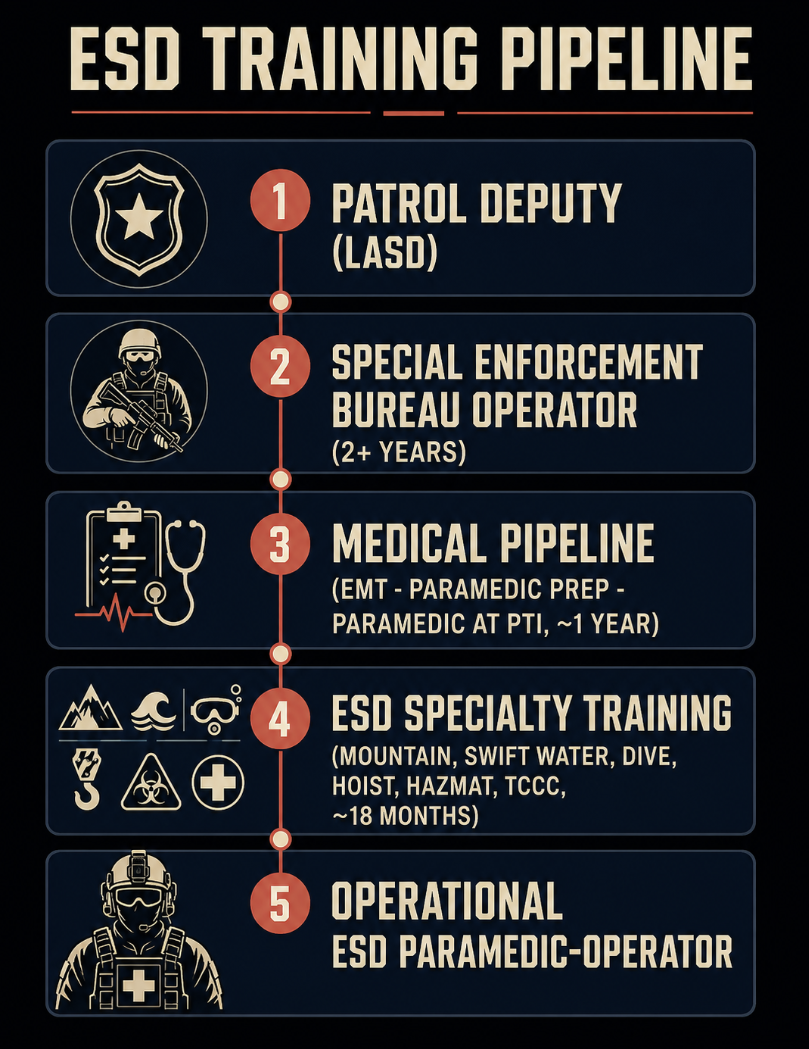
The minimum bar:
Serve in SEB for at least two years on the Special Weapons Team or in a feeder role
Successfully complete a one-year medical pipeline: EMT school, paramedic prep, and paramedic school
Approximately 18 months of specialized ESD training before the deputy is operational
LASD sends its paramedic candidates to the Paramedic Training Institute (PTI) — the same school that trains LA County Fire's paramedic ranks. That alignment matters. When an ESD medic walks a patient onto a county ambulance, the receiving fire paramedic was taught the same curriculum out of the same textbook. The handoff is clinical-shorthand fast.
The 18 months after paramedic school is where ESD diverges from a fire-based TEMS pipeline. Specialty certifications include:
SWAT and tactical operations (already in hand from the deputy's SEB years)
Rural and mountain rescue
Ocean and swift-water rescue
Helicopter-based rescue and rescue diving
Public safety diving
Combat medical and TCCC
Combat technical rescue and confined-space rescue and recovery
Tactical hazmat
Advanced underwater recovery
The LASD Tactical Medicine course itself is recognized by the California EMS Authority and California POST as meeting the state's requirements for medics attached to a SWAT team. It is one of the few law-enforcement-owned tactical medicine programs in the country with that dual EMSA/POST imprimatur.
By the time a deputy wears the patch, the agency has invested four to five years of training time and several hundred thousand dollars in tuition, schools, and certifications. The unit is not built for scale. It is built so that the call does not catch you short.
The Fleet: Air, Sea, Land
The Emergency Services Detail moves in three modes across three planes.
The MedCat
Lenco builds the BearCat armored personnel carrier that has become the standard heavy SWAT platform across US law enforcement. The MedCat is the medical variant — same Mil-Spec steel armor plate, rated to defeat multi-hit attacks from 7.62 AP and .50 BMG, with blast and fragmentation protection built into the floor and ceiling — configured as a rolling ALS bay. Onboard oxygen, lighted workstation with power inverter, overhead trauma lighting, IV hooks, suction, and rapid-response litter benches. LASD's MedCats are also fitted with a counter-IED electronic jammer, a radiation detection package, and an infrared combustible gas detection system. The crew is three paramedics. The mission is treatment and extraction inside the hot zone, where civilian EMS cannot stage and where the fire department's risk envelope ends.

This is the piece civilian medics misunderstand most. The MedCat is not a rolling clinic. It is a way to put advanced life support intervention five meters from a downed officer or hostage while gunfire is still possible. Tourniquet conversion, blood product administration, advanced airway, decompression — done under armor, in a vehicle that can drive itself out of the kill zone.
Air Rescue 5
LASD operates three Airbus AS332L1 Super Puma helicopters out of the Aero Bureau, first delivered in September 2012 as replacements for the agency's aging Sikorsky SH-3H Sea Kings. Each Super Puma flies with a crew of five: two deputy pilots, a sergeant crew chief, and two ESD deputy paramedics. The on-duty helicopter sits on a five-minute alert at a federal facility near the geographic center of LA County, seven days a week, so that a wheels-up call to any corner of the county lands within useful response time.

Air Rescue 5 covers an extraordinary mission set: technical rescue in the San Gabriel and Santa Monica mountains, swift-water rescue in flood control channels, medical transport from Santa Catalina Island, hoist insertions of SWAT operators on tactical jobs, and HEMS-equivalent ground evacuation of trauma patients. Across the LASD SAR network — Air Rescue 5 plus more than 150 Sheriff Reserve volunteers organized into eight Search and Rescue teams (Altadena, Sierra Madre, Antelope Valley, Malibu, Santa Clarita Valley, Montrose, San Dimas, and Avalon) — the department averages roughly 550 SAR missions a year, one of the highest call volumes of any sheriff agency in the nation.
The job is not without cost. On March 19, 2022, a Super Puma operating as Air Rescue 5 was destroyed in a brownout landing accident in San Gabriel Canyon during a HEMS flight to retrieve a road-accident patient. On board were two deputy pilots, two ESD deputy paramedics, a deputy crew chief, and a UCLA physician. All six survived — one critically, two with moderate injuries, two with minor — and three were treated and released the same day. The wreck reads, in retrospect, like one of those rare aviation accidents where the airframe absorbed everything it was built to absorb.
Marine & Dive
SEB Marine Operations and the ESD dive component cover Catalina, the coastal waters, and the swift-water inland sites. All ESD deputies are rescue divers; advanced underwater recovery is part of the specialty curriculum.

The Calls
The aggregate number is roughly 350 incidents per year for the detail itself, layered into the much larger SEB and SAR call volume. The mix is unusual.
On any given week, an ESD paramedic might run a barricaded-subject medical standby in Compton, a Class IV mountaineering rescue off the back side of Mount Wilson, a swift-water recovery in the Los Angeles River concrete channels after a winter storm, a Catalina Island medical transport, a hostage-rescue medical role on a high-risk warrant, and a downed-deputy contingency in a remote SAR sector.
The same person, same shift cycle, same kit reorganized for each environment.
The 2022 Mount Wilson rescue of a hiker and his dog who fell roughly 200 feet down a slope above the trail is the kind of call that does not make headlines but defines the unit's signature: Air Rescue 5 on scene quickly, ESD operators inserted to the patient, medical stabilization in place, hoist extraction, transport. A tactical EMS unit doing technical SAR with the same crew, same airframe, and same training base.
What Civilian EMS Can Take From LASD-ESD
The defining feature of ESD is selection. Almost everything else flows from there. A few specific elements are worth lifting and applying inside any civilian system.
Operator-First is a Model Worth Arguing About
Fire-based TEMS programs are not going to flip to law-enforcement-first selection, and they should not. But the underlying principle — that the medic should be a full team member rather than an attached specialist — is exportable. Tactical EMS programs that put medics inside the operational rhythm of the team, rather than adjacent to it, deliver better casualty care under the same threat profile.
The Pipeline is Honest About Cost
ESD does not market a six-week SWAT-medic course as adequate preparation. The unit accepts that producing a competent tactical paramedic-operator takes years, accepts the personnel cost, and runs the unit small. Civilian programs that have tried to scale tactical medicine on a shoestring have produced medics who get hurt or who get others hurt. The honest budget produces the honest unit.
Cross-Training is the Asset, Not the Resume Bullet
Every ESD deputy is a paramedic, a rescue diver, a mountain rescuer, a swift-water rescuer, a SWAT operator, and a hoist crewman. The cross-training is not a redundancy. It is how the unit fields three to four very different mission types without three to four very different unit structures. For agencies looking at community paramedicine, MIH, tactical, and SAR mission profiles separately, there is a model here for putting them in the same body.
Hot-Zone Medicine Requires Hot-Zone Protection
The MedCat exists because the medical mission inside an active threat profile cannot be done from a standard ambulance, and trying to do it from one will kill medics. Agencies that fund SWAT armor and TEMS training but will not fund the medical platform are doing the math wrong.
The Harder Questions
There are honest critiques of the model. The selection pipeline is narrow, and the unit's demographic mix has historically reflected that. Eric Lee, who became, by his own account, the first Black sergeant assigned to ESD when he moved over from SEB Canine and the Special Enforcement Detail, has spoken publicly about both the pipeline pride and the diversity gap. ESD is not unique in this — almost every elite tactical unit in American law enforcement faces the same pipeline math — but it does sit inside an agency that has been candid about wanting to broaden the pool. The pipeline is the reason and the pipeline is the answer.
There are also unresolved questions about the operator-medic role downstream. When the medic is also the second gun, who is the patient's advocate in the after-action review? How does dual-role identification affect care decisions under load? These are not ESD-specific. They are tactical-medicine-specific, and they belong on the training table at every level.
The Field-Editor Take
If you only remember one thing about LASD's Emergency Services Detail, remember that they treat the medic as an operator first and the paramedic credential as the second qualifier — and that this is not an arbitrary cultural choice. It is the outcome of a unit that decided decades ago that the cost of producing a tactical paramedic the slow way is lower than the cost of finding out, on a real call, that the medic in your stack is a passenger.
Most agencies will never have the headcount or the budget to copy ESD wholesale. That is fine. The pieces are still worth stealing — operator-grade selection, honest training time, cross-modal mission profile, hot-zone-rated platform. Pick what you can fund. Reject the temptation to call something tactical EMS because it has a vest in the equipment locker.
The unit's history runs from the 1958 protests to the San Gabriel summit ridge to the inside of an armored truck holding pressure on a deputy. The continuity is not the calls. It is the standard.

Sources
LA County Almanac, Emergency Services Detail entry (laalmanac.com/fire/fi25.php)
LASD Special Enforcement Bureau public manual sections (pars.lasd.org)
LASD official SEB About PDF and SEB Training pages (lasd.org/tccc-training)
Combat Operators feature on LASD SEB (combatoperators.com)
Lenco Armored Vehicles, MedCat / BearCat MedEvac product spec page
Air Rescue 5 program details, LASD press releases (lasd.org)
March 2022 Air Rescue 5 crash reporting: NBC News, CBS Los Angeles, KTLA, Aerossurance
Eric Lee profile, Black Peace Officers Association of LA County (bpoala.org)
California EMSA LASD Tactical Medicine Course announcement
LASD Search and Rescue program page (lasd.org/tbt-search-rescue)


Comments