
The Paramedic's Guide to TXA

A working clinician's guide to tranexamic acid in trauma (TXA) — the why, the when, and the calls people get wrong. Updated for the August 2025 NAEMSP/ACEP/ACS-COT joint position statement.
TXA Simply Stated
TXA helps clots stay clotted. In trauma patients who are bleeding badly, giving it early can save lives. Push it late and it can hurt. That's the entire drug in three sentences — but if you stop reading here, you'll get one of the calls wrong.
The three things every clinician needs to internalize:
Early use saves lives. The mortality benefit is real, measurable, and time dependent.
TXA is an adjunct — not a replacement. Hemorrhage control (pressure, tourniquets, binders) always comes first.
Timing is everything. Inside three hours, you may save a life. Past three hours, you may take one.
The Time Window: Why TXA Is Different
Most drugs in your bag have a therapeutic window measured in plasma levels and half-lives. TXA's window is measured by the clock on the wall.
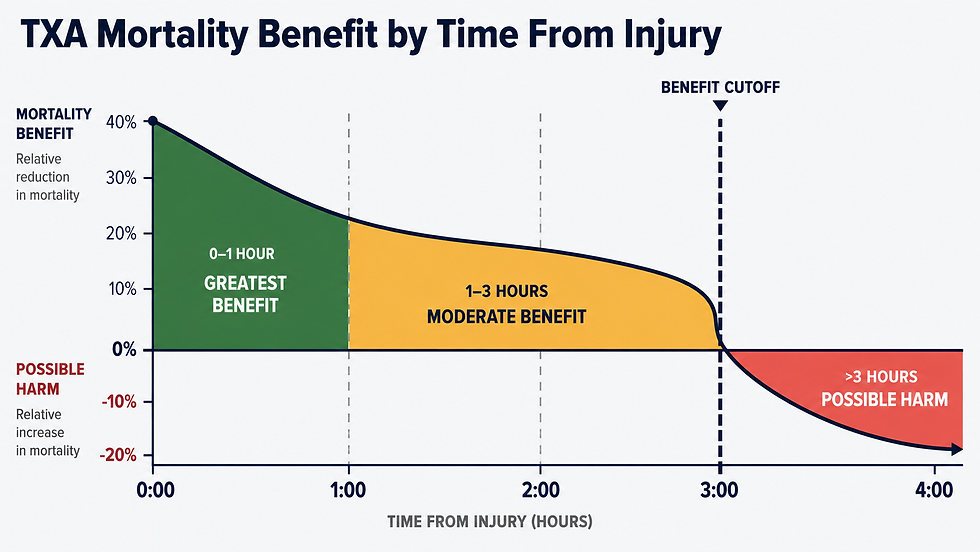
The original CRASH-2 data, plus every meta-analysis since, tells the same story: give TXA within the first hour after injury and the mortality benefit is dramatic. Between one and three hours, the benefit is smaller but still real. After three hours, the curve doesn't just flatten — it can reverse. Patients given TXA late may do worse than those given nothing.
This is unusual. Most drugs lose effectiveness as time passes; TXA actively becomes harmful. The biology is straightforward — by three hours, the body's fibrinolytic state has shifted, and adding an antifibrinolytic into a different physiological environment can drive thrombotic complications instead of reducing bleeding.
After three hours, you're not helping — you may be harming.
The Full TXA Guide
Tap any section to expand. Use the dosing table as your screenshot reference. Use the Common Mistakes section as your gut check.
How TXA Works (Mechanism of Action)
To understand why TXA works, you have to understand why severe trauma kills people who shouldn't be dying.
When the body is injured, two opposing systems activate almost simultaneously. Coagulation forms clots to stop bleeding. Fibrinolysis dissolves those same clots once healing is underway — normally a few hours later, when the patient is stable. In severe trauma, fibrinolysis switches on too early and too aggressively. The body is dissolving the same clots it's trying to form. This is trauma-induced coagulopathy, and it's a major contributor to deaths that look like "they should have survived that."

TXA is a synthetic lysine analog. Plasmin — the enzyme that breaks down fibrin — binds to lysine sites on the fibrin scaffolding. TXA occupies those same binding sites first, blocking plasmin competitively. The clot holds. Hemorrhage slows. The patient gets to the OR alive.
What TXA does NOT do:
TXA does not create new clots — it only stabilizes ones that already exist
TXA does not reverse anticoagulants like warfarin or apixaban
TXA does not fix bleeding without source control
If hemorrhage isn't controlled, TXA buys you minutes, not a solution
When to Give TXA (Indications)
If your patient is an adult, bleeding from trauma, showing signs of hemorrhagic shock, and you can get TXA into them within three hours of the injury — they're a candidate. The threshold is intentionally low, because the cost of missing a candidate is high and the cost of giving it appropriately is low.
Give TXA when you have:
Hemorrhagic shock from trauma — SBP < 90, HR > 110, or clinical signs of poor perfusion
Multisystem trauma with suspected significant internal hemorrhage
Penetrating torso trauma with any signs of shock
Severe blunt trauma with hypoperfusion signs
Any of the above within 3 hours of injury — always. Earlier is better.
Per medical control: postpartum hemorrhage, GI bleed, refractory epistaxis (varies by protocol)
When in doubt: lean toward giving it, as long as you're inside the window and your protocol allows it.
When NOT to Give TXA (Contraindications)
These are the calls where withholding TXA is the active intervention. Each one exists for a real reason — most of them traceable to a specific trial result or a known physiological risk.
Hold TXA for:
Past 3 hours from injury — benefit collapses, harm increases
Isolated TBI — without other significant trauma (see below)
Isolated spinal cord injury — same logic as isolated TBI
Controlled extremity bleeding — tourniquet or pressure has it stopped
Pediatric patients under 15 — most US EMS protocols (check yours)
Active thromboembolic disease — DVT, PE, acute MI, acute ischemic stroke
Known hypersensitivity — documented allergy to TXA
Seizure history — relative; high doses lower threshold
The Isolated TBI Trap
The word that matters is isolated. CRASH-3 looked at TBI alone and didn't find a clear benefit, which is why the contraindication exists. But a patient with multi-system trauma and a head injury is not an isolated TBI — they're a multi-system trauma patient who happens to have a head injury. They still get TXA.
This is the single most-confused contraindication in EMS, and getting it wrong cuts both ways: medics withhold TXA from patients who need it, or give it to patients who shouldn't have it. When unsure, ask: is there hemorrhagic shock from something other than the head? If yes, TXA is on the table.
Dosing
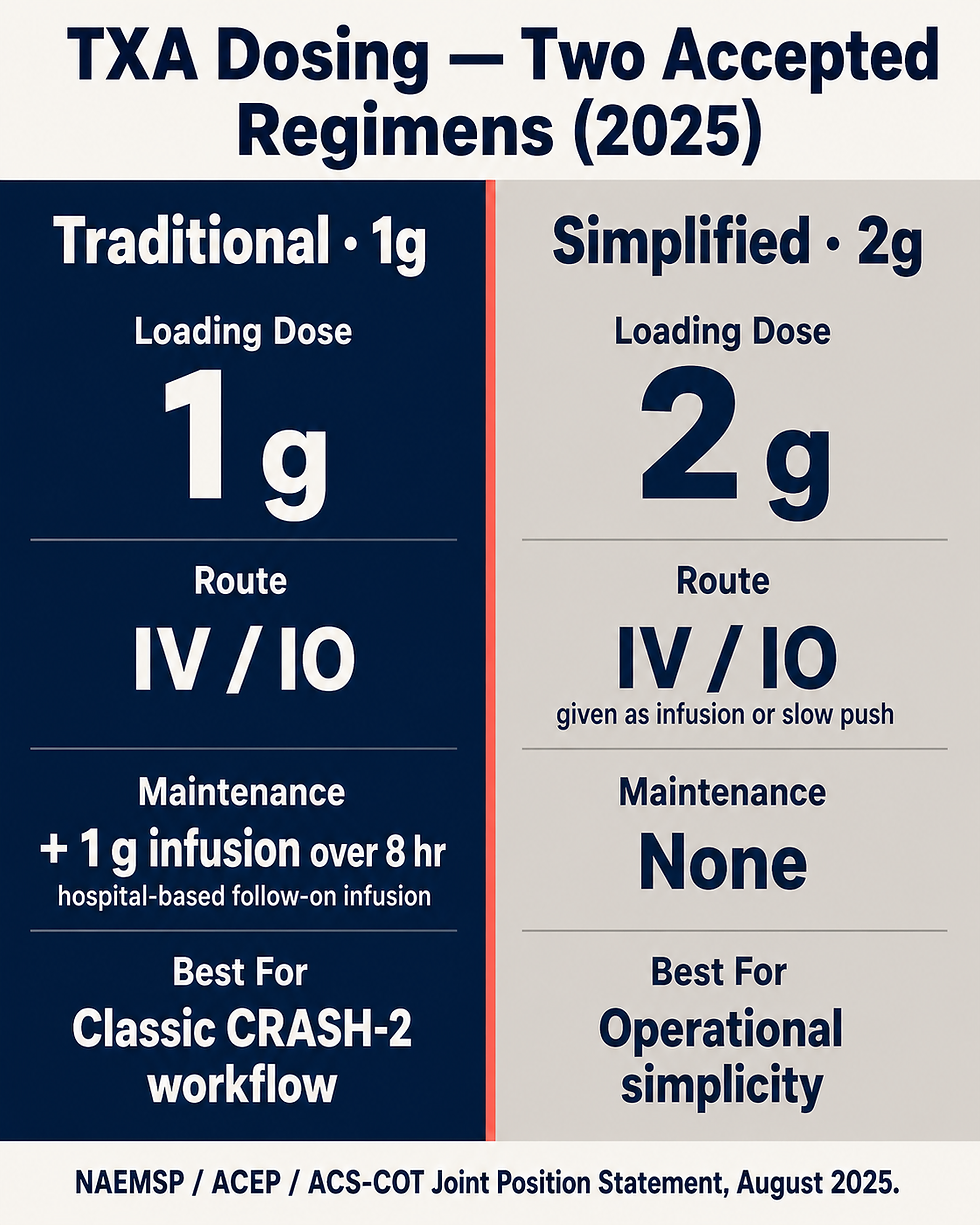
Two regimens are now widely accepted in the United States following the August 2025 NAEMSP / ACEP / ACS-COT joint position statement. Different agencies use different ones, and the variation isn't sloppy — it's a reasoned response to different operating environments.
Traditional Regimen | Simplified Regimen | |
Loading dose | 1 g IV/IO | 2 g IV/IO |
Route | Slow infusion over 10 min | Slow push or short infusion |
Maintenance | 1 g infusion over 8 hr (hospital) | None required |
Origin | CRASH-2 (2010) | 2025 joint statement |
Best for | Systems with hospital coordination and longer transports | High-tempo EMS, mass casualty, austere environments |
Pediatric dosing — verify your protocol
If your protocol authorizes pediatric TXA, the typical dose is 15 mg/kg IV/IO (max 1 g). Most US EMS protocols do NOT authorize pediatric TXA at all. CRASH-2 and CRASH-3 excluded pediatric patients, the evidence base is thin, and high doses have been associated with seizure risk. Don't assume your service carries pediatric TXA authority — check.
Whichever regimen your agency uses, the choice belongs to your medical director — not to you. If you think your protocol should change, that's a conversation for QA, not the back of the truck.
Special Considerations & Field Tips
The things that show up on the second-to-last page of the protocol document, but matter on the truck:
Document time of injury AND time of administration. Both. Every time. This is the receiving facility's first question and your medical director's first audit point.
Mix in 100 mL NS and infuse slow. Rapid IV push of the 1 g regimen can cause hypotension — exactly what your bleeding patient doesn't need.
IO is fine when IV access isn't. Same dose, same effect. Don't delay administration trying for a second peripheral.
Don't run TXA in the same line as blood products. Avoid precipitation. Use a Y-site or a second line.
Hemorrhage control comes first. Direct pressure, tourniquets, pelvic binder, then TXA. If you reverse the order, you're treating the wrong thing.
If you can give it in the first hour, do. The benefit curve is steep. A dose at 45 minutes is worth significantly more than the same dose at 2 hours 45 minutes.
Notify the receiving facility of administration time and dose during your radio report. It changes what they hang on arrival.
In mass casualty: the 2 g push regimen is your friend. Faster to administer, frees you to move to the next patient.
The Evidence
If you're going to push a drug into a critically injured patient, you should know what the data actually says. Here's the short version of the studies your medical director is reading.
CRASH-2 (2010) · n = 20,211
Established the mortality benefit and the 3-hour window. The foundational trial — every modern TXA protocol traces back to it.
MATTERs (2012) · Combat trauma
Confirmed benefit in penetrating military trauma. Pushed adoption in tactical medicine and contributed to TCCC guidelines.
CRASH-3 (2019) · Isolated TBI
Did NOT show clear benefit in isolated TBI. This trial is the reason "isolated TBI" appears on every contraindication list.
PATCH-Trauma (2023) · Prehospital, 6-month outcomes
Survival benefit without clear functional improvement at 6 months. Mixed signal that complicated the conversation but didn't change practice.
EAST Guidelines (2024 update) · Meta-analysis
Reinforced early administration. Provided the consolidated evidence base the 2025 joint statement built on.
NAEMSP / ACEP / ACS-COT (August 2025) · Joint position statement
Current US consensus. Endorsed both 1g and 2g dosing regimens. The document your protocol committee is referencing right now.
Common Mistakes
None of these are theoretical. All of them happen on real trucks, by competent medics, every shift, somewhere. Read them carefully — at least one is probably a habit you didn't know you had.

1. Giving TXA past the 3-hour window because "what's the harm"
The harm is increased mortality. This is the most common preventable error with TXA. The instinct that "more medicine is always better" doesn't apply here — the drug's biology genuinely flips past three hours. If you're outside the window, the answer is no.
2. Giving TXA to an isolated TBI because the patient "looks bad"
Looking bad isn't an indication. Hemorrhagic shock is. CRASH-3 settled this — isolated TBI doesn't benefit from TXA, and the risk-benefit calculation doesn't change because the patient's GCS is low. Rapid transport to a neurotrauma center is what saves them, not TXA.
3. Withholding TXA from multi-system trauma because there's also a head injury
The other side of the same coin. A patient with chest, abdominal, or pelvic trauma and a head injury is not an isolated TBI. They need TXA. Misapplying the contraindication kills patients quietly — there's no obvious moment of failure, just a slow bleed-out that could have been slowed down.
4. Giving TXA before hemorrhage is controlled
TXA stabilizes clots. It does not form them, and it does not stop active arterial bleeding. If you push TXA before applying the tourniquet, the pelvic binder, or direct pressure, you're treating the wrong problem in the wrong order. Source control first. Always.
5. Pushing TXA fast because the patient is crashing
Rapid IV push of the 1 g regimen causes hypotension. Your already-hypotensive patient gets worse, you panic, and now you're treating an iatrogenic problem on top of the original one. Slow infusion. Always. If you're using the 2 g regimen, "slow push" still means slow — not 30 seconds.
References
1. CRASH-2 trial collaborators. "Effects of tranexamic acid on death, vascular occlusive events, and blood transfusion in trauma patients with significant haemorrhage (CRASH-2): a randomised, placebo-controlled trial." Lancet. 2010;376(9734):23–32. PubMed
2. Morrison JJ, Dubose JJ, Rasmussen TE, Midwinter MJ. "Military Application of Tranexamic Acid in Trauma Emergency Resuscitation (MATTERs) Study." Arch Surg. 2012;147(2):113–119. PubMed
3. CRASH-3 trial collaborators. "Effects of tranexamic acid on death, disability, vascular occlusive events and other morbidities in patients with acute traumatic brain injury (CRASH-3): a randomised, placebo-controlled trial." Lancet. 2019;394(10210):1713–1723. The Lancet
4. PATCH-Trauma Investigators. "Prehospital Tranexamic Acid for Severe Trauma." N Engl J Med. 2023;389(2):127–136. NEJM
5. Gayet-Ageron A, Prieto-Merino D, Ker K, et al. "Effect of treatment delay on the effectiveness and safety of antifibrinolytics in acute severe haemorrhage." Lancet. 2018;391(10116):125–132. PubMed
6. NAEMSP, ACEP, ACS-COT. "Prehospital Trauma Compendium: Tranexamic Acid in Trauma — A Joint Position Statement and Resource Document." Prehosp Emerg Care. 2025. Full text
A New Way to Learn EMS Pharmacology
Pharmacology is hard because the way we teach it doesn't match how the brain retains complex clinical information. RXQuest fixes that with three things that change everything: spaced repetition so what you study actually sticks, live-vitals case scenarios that build the muscle memory of using a drug under pressure, and scope-aware filtering so you're never wading through content above or below your certification level. It's pharmacology training built the way the brain actually learns. Tap the image to learn more.


Comments