
Too Close for Blood: The Argument That Hospital Proximity Kills Prehospital Blood Programs — And Why It Doesn't

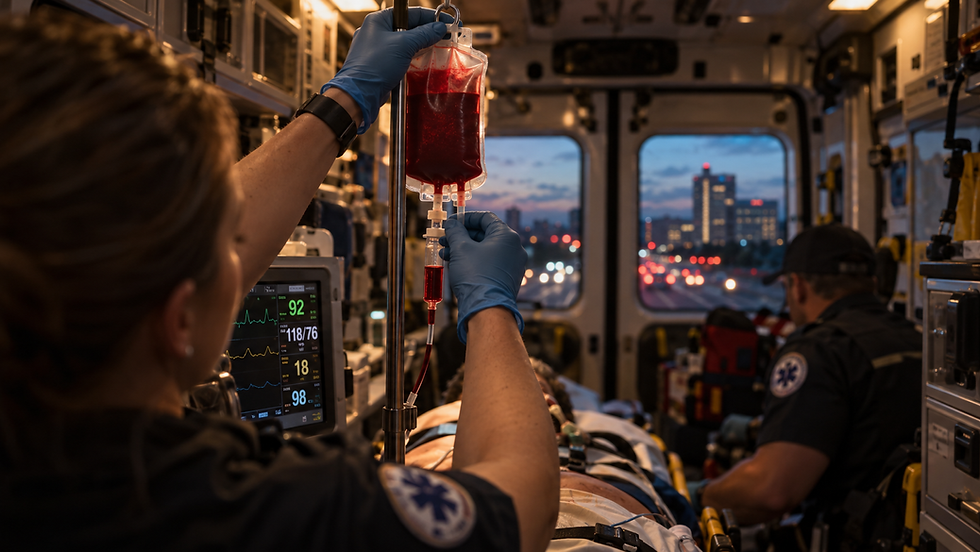
The argument shows up in every budget cycle. Someone from finance — sometimes the medical director, more often not — clears their throat and says a version of the same sentence. We're an urban system. Our transport times are short.
Do we really need to spend hundreds of thousands of dollars a year on a prehospital blood program?
The room usually nods. On paper, it plays. On the actual paper — the run sheets and the trauma-registry pulls — it collapses.
This is the "too close for blood" argument, and it deserves a serious response. Not the reflexive "we should carry blood everywhere" one. A serious one, drawn from the same registries and randomized trials that leadership is quoting when they say no. Because the honest answer is not that every urban ambulance must carry two units of LTOWB. The honest answer is that the argument leadership is making is the wrong argument, built on a version of "close" that does not exist in the field.
The Argument on Paper: Blood Programs
The proximity case has three legs. Cost — a well-run program runs roughly $150,000 to $400,000 (or more) per year per agency in blood product, cold-chain equipment, training, and QA overhead. Trial evidence — SWiFT and TOWAR, the two large 2026 pragmatic RCTs of prehospital whole blood, both landed on no mortality benefit versus components. And logistics — short urban transport times, the story goes, don't give a unit of blood enough hang time to matter.
Each of those legs is defensible in isolation. Stack them and the conclusion sounds inevitable: urban systems should let hospitals do transfusion, and EMS should drive.
Except that's not what the trials said. And it's not what the transport-time data looks like on a real Tuesday.
What "Close" Actually Means on the Clock
Start with the number leadership never actually pulls up. The National Emergency Medical Services Information System (NEMSIS) analysis of more than 69 million EMS calls from January 2023 through January 2025 puts the national average total call time — response, on-scene, and transport combined — at 74.1 minutes. High-acuity calls run 69 minutes nationally, 97 minutes in rural systems.
Those are call times, not transport times. Fair enough. Break out just the trauma transport phase and it still doesn't behave the way the "we're close" argument assumes. In a North Carolina trauma-registry analysis, mean scene time was 14.2 minutes and mean transport time was 17.5 minutes, with only 35.3% of encounters clearing scene inside the NHTSA-recommended 10-minute window. That is scene plus transport of just under 32 minutes — before the ED bed, before offload, before wall-time.

Now layer on the offload problem. A 2025 descriptive analysis of ambulance patient offload times (APOT) in the United States found urban systems disproportionately affected by wall time, with individual events routinely stretching past 30 minutes at the receiving hospital. When leadership says "we're close to a hospital," they mean the physical distance from a scene to a trauma-center loading bay. When a trauma patient bleeds, the clock that matters runs from "help me" to transfusion started. Those clocks are not the same.
The most granular urban model on record — a simulation of prehospital travel times in a dense US city published in 2025 — found that 11% of transport intervals in that city were long enough to complete a full unit of whole b
lood transfusion en route. Eleven percent is the number leadership hears when they say "we're close." What they don't hear is that 11% of a high-volume urban 911 system's trauma volume is a lot of dead patients.

None of that means every unit needs a blood cooler. It does mean the framing "our patients are close to the hospital" is a claim about the geography of buildings, not the physiology of exsanguination.
What SWiFT and TOWAR Actually Said (and Didn't)
The two 2026 trials get quoted more than they get read. Both deserve to be quoted correctly.
SWiFT, published in the New England Journal of Medicine, randomized 616 trauma patients with life-threatening hemorrhage across 10 UK air-ambulance services to prehospital whole blood or standard component therapy. The primary outcome — a composite of death or requirement for massive transfusion at 24 hours — landed at 48.7% versus 47.7%, adjusted risk ratio 1.02. No signal for whole blood.
TOWAR, out of the University of Pittsburgh and published in NEJM in May 2026, randomized 1,020 patients across 44 US air-medical bases. Same conclusion. No mortality benefit. In the words of the Emergency Trauma Management commentary that followed both trials, "not superior, not settled."
That last phrase is where the honest read starts. What both trials tested was whole blood against component therapy, in physician-staffed HEMS systems, with well-stocked helicopters and short prehospital timelines. Not whole blood against nothing. Not urban ground ambulances with 22-minute door-to-door times and crystalloid as the only alternative to a hospital transfusion.
The clinical trials that actually spoke to short urban ground transport already existed. COMBAT, published in The Lancet in 2018, randomized urban Denver ground EMS patients with a median transport time of 18 minutes to prehospital plasma versus saline. No benefit. PAMPer, in the same year, randomized HEMS patients with a median transport time of 41 minutes to plasma versus standard care. A 10% absolute mortality reduction. When Pusateri et al. combined the two datasets in a 2019 post hoc analysis, they found the plasma benefit emerged past 20 minutes of transport time.
That is the finding leadership should be quoting. It is not "urban systems don't need prehospital blood." It is "proximity attenuates the marginal benefit of prehospital transfusion, and the inflection point sits at roughly 20 minutes of transport." Roughly a third of urban trauma transports cross that line under NEMSIS data. Not most. Not none. A meaningful population — and one that overlaps almost perfectly with the sickest patients, because time to trauma center is not distributed evenly across acuity.
The Mindset Problem
Here is where the "we're close" argument does its worst damage, and here is where the evidence is harder to quote because the outcome you'd need to measure is a habit of practice, not a mortality endpoint.
When an agency's leadership repeats "we're close to a hospital" as the reason not to carry blood, that language does not stay in the budget meeting. It moves out to the trucks. It shapes the mental model medics build about hemorrhagic shock: this patient needs surgery, so we scoop and we run. The corollary — and we don't do much else, because doing much else takes time — follows without anyone naming it.
The scoop-and-run literature is genuinely mixed, and Black Flag has been on record about that mix. A 10-minute delay on scene beyond expected load-time is associated with a 33% increase in 24-hour mortality in urban penetrating trauma; that finding is real, and it is often correctly applied. But the same literature keeps flagging a different failure mode: prehospital interventions that were skipped, not because the patient didn't need them, but because the medic was drilled into a load-and-go reflex that treated every intervention as a delay. TXA that never went in. Tourniquet reassessments that never happened. Junctional hemorrhage that never got a wound pack because the truck was already rolling.
The medic who works in a system that treats hospital proximity as the answer to bleeding will, over hundreds of shifts, quietly stop escalating anything on the truck. That is not a failure of the individual medic. It is a rational adaptation to the frame the agency handed them. And it is the reason the "we're close" argument is more expensive than its dollar figure suggests. You do not just lose the blood benefit for the 11–33% of transports where blood would have helped. You lose the operating tempo that would have kept those patients alive during the 30-minute delta between "in the truck" and "in the trauma bay."
The Murphy Factor
The clean version of the urban transport story assumes the day goes the way the map goes. Real days do not.
Consider the failure modes an urban system actually eats. High-rise buildings with elevators that are not keyed, or that are keyed for fire but not for the med-bag stretcher, produce a documented delay in EMS interventions and CPR quality. Motor vehicle collisions with entrapment produce extrication times that, in a 2016 analysis of 164,471 patients, did not independently increase mortality — but only because the analysis controlled for the fact that transport does not start until extrication ends. Prolonged treatment scene time was directly associated with increased mortality in the same dataset. Confined-space rescues, shipyards, construction sites, the bottom of a subway station, a factory floor half a mile from the closest ambulance-parkable curb. All of these turn "our transport times are short" into a lie the map told you.
And that is before the weather-and-politics tier. Active shooters push EMS to cold-zone staging while the patient bleeds in a warm zone. Hazmat events push scene time past an hour. Hurricanes and wildfires — Ida, Helene, the 2025 Maui event, the January 2025 Los Angeles fires — pulled apart the assumption that any specific urban trauma patient will move on any specific timeline. Mass casualty events do the same at smaller scales every week.
Leadership evaluating a blood program on a flat average transport time is evaluating the median day. The patient who needs blood is not on the median day. That patient is on the day when the elevator is out, the exit ramp is closed, the police cordon is up, or the ambulance is stuck behind a 40-truck refinery evacuation. If the answer to "should we spend money on blood?" is "not for the median case," the answer to "should we have a way to get blood to the patient on the tail day?" has to be yes — and yes means a program, not an absence of one.

A Framework Instead of a Binary
The binary is the mistake. "Every unit carries blood" and "no unit carries blood" are both bad answers because they both assume the transport-time distribution and the Murphy distribution are constants. Neither is.
A defensible urban framework has three levels.
The Foundation— Protocolized preservation of the patient's own physiology while the transport clock runs. TXA within 3 hours per CRASH-2 remains as strong an intervention as any prehospital pharmacology touching hemorrhagic shock. Peripheral norepinephrine per SPOTLESS-2 is defensible for the shocked patient whose transport is prolonged. Tourniquet reassessment, junctional wound packing, pelvic binder placement — none of which take significant time when the muscle memory is drilled — do not lose their value because a hospital is theoretically 15 minutes away. They lose their value only in a system that treats every prehospital intervention as a delay.
Level 1 — Rapid response units with blood aboard, geographically distributed. These are the ones the San Antonio program, the DC Fire & EMS program, and the Pittsburgh Bureau of EMS have built out. In a 2022 update, San Antonio's regional program reported prehospital transfusion in patients with hemorrhagic shock across a mixed urban-rural catchment, with survival benefits mirroring the observational literature. In September 2025, Pittsburgh expanded from a physician-paramedic model to independent paramedic transfusion. In September 2026, AHN began rolling blood out to five Pittsburgh-area suburban agencies. Not every unit. The right units, in the right places, with the right training, and with a clear activation criterion.
Level 2 — An escalation pathway that gets blood to the patient when the standard transport plan fails. This is the piece most agencies without a full program are missing. A high-rise entrapment stretches to 40 minutes. An extrication runs 30 minutes past dispatch estimate. A hazmat scene pushes decon delays out. The question the system should be able to answer in under 5 minutes: can we get a blood-carrying asset — HEMS, a supervisor unit, a trauma-center liaison — to this scene now? Systems without a Tier 1 program still need this pathway, and the argument for building it does not depend on the trial data. It depends on the Murphy factor.
The widget below makes readers work the same Murphy-factor decisions on scenarios they have not personally faced and lets them see whether their default frame — carry blood, don't carry blood, activate escalation, transport only — survives contact with the geometry of a real bad day.
What This Costs When You Get It Wrong
The 2026 NHTSA EMS Office guidance frames the number bluntly: patients with severe hemorrhage who receive prehospital whole blood are approximately 4x more likely to survive.
Every 1-minute delay in blood administration is associated with an 11% increase in mortality risk.
Those numbers are drawn from observational registries and should be treated with the usual caveats — sicker patients get blood, and the confounders are real. But even the conservative version of that finding, taken from the SWiFT/TOWAR-adjacent literature and constrained to the transport-time-attenuated benefit past 20 minutes, produces a meaningful lives-saved figure at population scale. The Pittsburgh coalition's simulations put national estimates in the thousands of lives per year.
Against a program cost of a few hundred thousand dollars per agency per year, and against the alternative of a scoop-and-run mentality that quietly erodes the entire prehospital repertoire, the "we're too close" position is not the frugal choice. It is the choice that pretends the tail of the transport-time distribution — the 20-minute-plus tail, where the trials say the benefit lives, and where the Murphy days live — is somebody else's problem. It is not somebody else's problem. It is the problem.
Where This Leaves the Working Medic
None of this is an argument to walk into your medical director's office demanding LTOWB in every truck. It is an argument to walk into the same office with three questions.
What does our transport-time distribution actually look like, at the 75th and 90th percentiles, for hemorrhagic-shock activations — not the median?
If a Murphy-factor day cost us 45 minutes on scene, what asset in our system could put blood at the patient, and how fast?
What is our written escalation pathway, and when did we last drill it?
If leadership can answer those three cleanly, they've earned the "no blood on the truck" position. If they cannot — and most systems using the proximity argument cannot — the argument is not that the program is wasted money. The argument is that the leadership has not looked at the distribution they are betting the tail against.
Comments open. If your system runs the "too close" argument and has flipped, it — or has failed to — the field wants to hear it. Especially the how.


Comments