
Traumatic Hypotension: To Pressor or Not To Pressor

Recently I was talking with two people whose judgment I respect: the program director of a paramedic school and the school’s medical director. We got onto a question I thought I ought to be able to answer. Why would I give norepinephrine to a hypotensive trauma patient?
I had a reason for asking. During time I spent with one EMS agency, I encountered a pathway in which norepinephrine could enter the discussion for an injured patient with persistent hypotension and altered mentation. My mentors raised a fair challenge. What evidence says that giving the drug in that situation helps the patient?
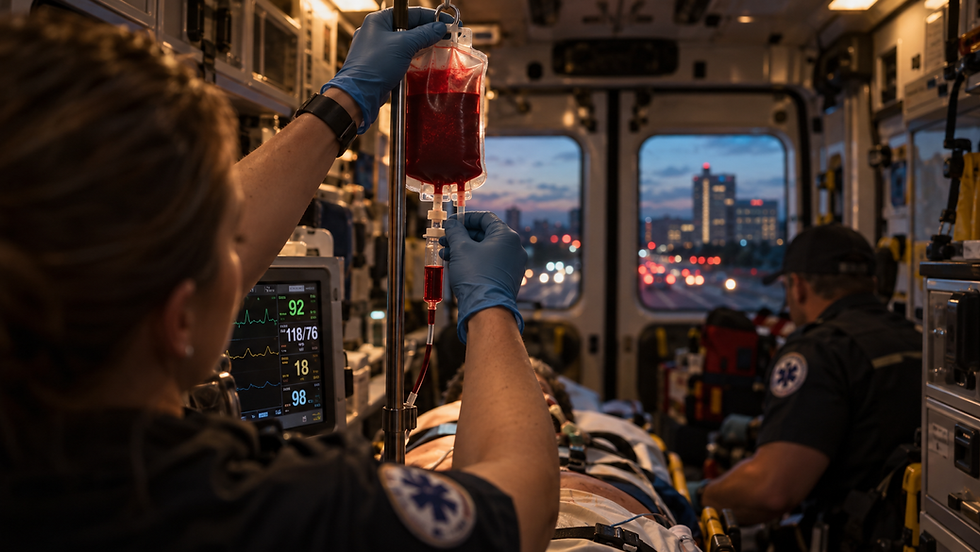
Here’s the case that keeps me interested. An adult driver is pinned. The crew has controlled the bleeding it can reach. Fluid is going through a working line. The patient still has a pulse, but the pressure is 75/59. The trauma center is ten minutes away by road. Nobody expects to have this patient on that road for another forty-five minutes.
Now I have two questions. What should I do for this patient while we’re here? And if I give a pressor under an authorized protocol and the pressure comes up, what will convince me that I’ve helped?
Which Patient Are We Talking About?
An injury can lower blood pressure through blood loss, impaired cardiac filling, pump failure or loss of vascular tone. Several can coexist. For the pressor question, I’m starting with an adult who has a pulse and suspected traumatic hemorrhagic shock. Pediatrics deserves its own discussion. So does an isolated spinal cord injury with neurogenic shock. [1,2]
When bleeding is still active, permissive hypotension means accepting a lower pressure during resuscitation while working toward hemorrhage control. We aren’t trying to make the patient hypotensive. The European major-bleeding guideline gives a systolic target of 80–90 mmHg for its initial strategy in patients without clinical evidence of brain injury. Suspected significant traumatic brain injury changes the goal because hypotension threatens cerebral perfusion. The Brain Trauma Foundation’s prehospital adult guidance uses a systolic goal of at least 110 mmHg. I would never look at an unconscious driver with a systolic of 88 and declare that we’d reached the right target without considering the head injury. [2,3]
Blood products matter in hemorrhagic shock because the patient has lost circulating volume and oxygen-carrying red cells. Where blood is unavailable, isotonic crystalloid can provide temporary volume support, with reassessment after each increment. I have my preferences about saline and lactated Ringer’s. Neither choice answers today’s question: what if the pressure won’t hold despite the resuscitation available to my crew? [2,4,5]
How Two Groups Reached Different Recommendations About Pressors
The US National Association of EMS Physicians (NAEMSP) recommends against prehospital vasopressors for traumatic hemorrhagic shock, including hypotension that persists after volume expansion. Three observational studies informed that recommendation. Two civilian studies by Gauss and colleagues found no clear survival advantage from early norepinephrine. The larger study included 2,164 blunt-trauma patients who arrived at hospital alive. In 525 patients, the infusion actually began in the resuscitation room. That distinction matters to the medic deciding whether to start it at the roadside. [1,6,7]
The third study, by Fisher and colleagues, deserves a closer look. The investigators searched Department of Defense Trauma Registry records from 2007 to 2016. Among 28,222 casualties, 124 had documented prehospital vasopressor use. In the matched comparison, survival to discharge was 71.3% among pressor recipients and 94.3% among comparison patients. The investigators adjusted for factors including injury severity, injury mechanism, prehospital heart rate and systolic pressure, and total blood products transfused. The association with lower survival persisted. NAEMSP also reported that injury severity remained higher among pressor recipients after matching. [1,8]
Imagine two casualties whose charted systolic pressure is 75. One has climbed to 75 after bleeding control. The other has fallen to 75 and is deteriorating in front of the medic. Which is more likely to receive a pressor? Which is more likely to die regardless of what the medic does? That is the problem with trying to reconstruct the treatment decision from a registry. There was a comparison group, and the investigators took the differences seriously. The result warrants caution. It cannot tell us how many of those casualties would have survived had the medic withheld the drug. The accessible abstract also does not give us the individual doses or fluid-before-drug timelines needed to reconstruct those cases. [1,8]
The European document is a major-bleeding guideline. Its authors recommend adding norepinephrine to fluids when restricted volume replacement fails to reach the appropriate pressure. Their rationale describes temporary use in profound hemorrhage-induced hypotension, specifically a systolic pressure below 80 mmHg in that setting, while work to stop the bleeding continues. The recommendation is Grade 1C: strong recommendation, low-quality supporting evidence. “Temporary” describes the intended period of support. It supplies no instruction to give a push-dose bolus. The authors also raise a concern particularly relevant to a casualty whose vessels are already tightly constricted: further vasoconstriction could reduce organ blood flow. [2]
These groups disagree at the very point where our pinned driver sits. Both positions deserve an accurate reading. A 2026 systematic review found five retrospective studies of prehospital vasopressor infusion and judged the evidence very low certainty. We have reasonable grounds to advise against routine use in hemorrhagic shock. We still cannot tell a crew that starting norepinephrine in this particular prolonged, profoundly hypotensive case will improve survival. The European recommendation is something an agency medical director can evaluate; the decision at the patient’s side follows the crew’s protocol and medical direction. [1,2,9]
Why My Sepsis Instincts Can Mislead Me Here
In septic shock, loss of vascular tone can be a major reason blood pressure is low. Norepinephrine can restore some of that tone and increase the pressure driving blood through organs. Venous constriction can also recruit blood back toward the heart. Volume status still matters in sepsis, and clinicians still have to treat the infection. There is nevertheless a physiological problem the drug directly addresses. That is why norepinephrine is the usual first-line vasopressor in adult septic shock. [10]
Our bleeding driver may have a different problem. The heart may have too little blood returning to it, the remaining blood may carry less oxygen after crystalloid resuscitation, and the body may already be constricting vessels vigorously. Norepinephrine might improve perfusion pressure or venous return. It might also raise arterial resistance while forward flow remains poor. Later in hemorrhagic shock, loss of vascular tone can make the picture more complicated still. The cuff measures pressure. Tissue oxygen delivery depends on the volume of blood flowing and the oxygen it carries. [2,7]
I initially called a rising pressure a “false positive.” What I really mean is false reassurance. The pressure rise can be entirely real. The mistake would be seeing a number we wanted, letting out a deep breath, and deciding the shock had resolved. That is my clinical teaching point. Fisher did not show that false reassurance caused deaths, and the European authors’ warning about reduced organ flow does not establish that it happened to those combat casualties. [1,2,8]
My Unconscious Patient Goes from 75/59 to 88/77. Now What?
If an awake patient who was barely answering me begins speaking clearly, that change matters. If their pressure improves and their mentation fails to improve, I reassess. Head injury, hypoxia, medications and other causes can alter consciousness. Mentation is useful evidence when interpretable. It cannot tell me on its own whether a pressor worked. [3,11]
The harder case is the unconscious patient. Let’s say we’ve given norepinephrine under an authorized pathway. 75/59 becomes 88/77. Assuming accurate measurements, estimated mean arterial pressure rose from about 64 to 81 mmHg. Pulse pressure, the difference between systolic and diastolic, narrowed from 16 to 11. The diastolic reading accounts for much of the apparent improvement. Those numbers are compatible with increased vascular tone and persistently low stroke volume. Two cuff readings cannot tell me what happened to cardiac output. I also don’t need to pretend the patient got no benefit. A patient can improve and still be in shock. [2,12]
What I want next is evidence that comes from somewhere other than that cuff:
What I can assess? | How it changes my interpretation? |
Repeat pressure, pulse quality and skin perfusion. | Verify the reading with an appropriate cuff, manually if feasible. Compare central and peripheral pulse quality, capillary refill, skin temperature and mottling over time. A sustained pressure rise with stronger peripheral pulses and improving refill is more encouraging than a higher pressure alone. Cold and the pressor itself can affect the skin examination. [11,12] |
Waveform end-tidal CO₂ if the patient is intubated. | With airway position, ventilation and waveform stable, falling ETCO₂ can signal that less blood is bringing CO₂ to the lungs. If ETCO₂ falls as the cuff pressure rises, I check the airway, ventilation, chest and circulation again. A change in ventilation can move ETCO₂ independently of perfusion. [3,13] |
Ultrasound or serial metabolic measurements, where available. | A trained clinician can use focused cardiac ultrasound to assess filling, pump function or pericardial fluid. Serial lactate, or base deficit when lactate is unavailable, can add evidence about the trajectory. Neither is an instant verdict on a drug dose. A negative abdominal FAST cannot clear the abdomen or retroperitoneum of bleeding. [2,12,14] |
In a basic ALS unit, I may never be able to prove adequate organ perfusion during the encounter. I can still be precise in my handoff: “Pressure responded. Peripheral pulses remain weak. Ventilation is unchanged and ETCO₂ is falling. I’m still concerned about low flow.” That gives the next clinician more useful information than “the patient stabilized.” [11–13]
Suppose We Really Did Stop the Bleeding
I don’t want the whole lesson to amount to “go find the mistake.” Start by respecting the possibility that the crew did exactly what it was supposed to do. A tourniquet can be effective, packing can hold, and a patient can still be profoundly hypovolemic from the blood already lost. Stopping blood loss and restoring circulating volume are two different accomplishments. [2,11]
I would work through four questions, revisiting them as access to the patient improves:
What was controlled, and what actually reached the circulation? Reinspect the treated wound after movement. Verify access, infusion flow, the amount delivered and how long any response lasted. A dry thigh wound leaves open the possibility of blood in the chest, abdomen or pelvis. If there is no further bleeding anywhere, the original volume and red-cell deficit may still be substantial. [2,4,11]
Can blood get back into the heart? Chest injury followed by worsening ventilation and shock raises concern for tension pneumothorax. Penetrating chest injury raises concern for tamponade. A sudden decline immediately after positive-pressure ventilation calls for reassessment of the airway, ventilation and chest. These are causes of obstructive shock. Treat a compatible reversible cause within scope. Increasing vascular tone cannot decompress a chest or a pericardium. [1,2,14]
Can the heart pump what returns? Blunt cardiac injury or a serious dysrhythmia can reduce output. Check the rhythm and use cardiac ultrasound when available. The European guideline specifically says that poor response to volume and norepinephrine should raise suspicion of myocardial dysfunction. Hypothermia, severe acidemia and low ionized calcium, especially during substantial transfusion, can further complicate resuscitation. [2,12]
Has vascular tone fallen for a different reason? Spinal cord injury, induction drugs or a medical illness that preceded the injury can change the working diagnosis. Bradycardia in a patient with possible cord injury is a clue, and hemorrhage can coexist. The question for medical direction becomes “what mechanism are we treating now?” [1,2]
Think in Hours, Even When the GPS says Minutes
One habit I try to teach is to imagine what this call looks like if we still have the patient an hour from now. A trauma center ten minutes away offers no immediate access to an operating room for someone who is still pinned. Poor weather, a failed intercept or a change in extrication plan can turn a short call into a prolonged one. NAEMSP itself acknowledges that available evidence does not adequately address these environments. [1,11]
If we carry blood and the patient meets transfusion criteria, we can start under protocol while hemorrhage control continues. If we carry only crystalloid, use protocol-directed increments, keep a running total, and reassess what each one achieved. Protect the patient from heat loss. Consider TXA when indicated under protocol. If moving the patient is physically impossible, use that time to bring blood, advanced personnel or medical direction to the scene. Once release is possible, reassess whether an intercept en route will save time. With a single clinician at the patient’s side, whoever has hands on effective hemorrhage control needs a real handoff before taking on another task. A long delay increases urgency. It does not tell us which drug will work. [2,4,5,11,15]
Consider what the receiving center can do with this report: “Unconscious adult, pulse present. External thigh bleeding controlled. Initial pressure 75/59, now 88/77 on norepinephrine under protocol. Internal loss still possible. We have no blood, and we’re at least forty minutes from release. Can you bring blood to us or intercept us on the route, and activate the hemorrhage team now?” On a real call, add the actual fluid volume, drug delivery, airway findings and perfusion trends. An estimated release time gives the receiving team something it can act on before the wheels move.
In a capable trauma center, warmed blood products and preparations for hemorrhage control proceed in parallel. An unstable patient with evidence of major abdominal bleeding may go directly to an operating room with only enough imaging to direct the intervention. Active arterial pelvic bleeding may call for embolization, depending on the injuries and resources. The crew may have identified the problem correctly at the roadside forty minutes earlier. The difference at the hospital is the ability to stop it. [2,14]
What I Would Take Back to My Agency
I would ask our medical director three questions. What physiology is our pressor pathway intended to treat? What patient findings would make us reconsider that choice? What can our system deliver during the hour before definitive care? Those questions apply whether an agency follows NAEMSP’s recommendation against prehospital pressors for refractory hemorrhagic shock or permits temporary norepinephrine in the narrow circumstances described in European guidance. [1,2]
I believe vasopressors likely have a place in selected patients with traumatic hypotension. In suspected hemorrhagic shock, routine field use has no demonstrated survival benefit. What I want from further research is specific: which patients received the drug, what had already been done, how perfusion changed, and whether more patients survived with good function. That would help us judge when a pressor adds value to the resuscitation. [1,2,9]
If an agency authorizes a pressor for this situation, I want its protocol and training to give the crew a way to test its reasoning. Before starting it, the medic should be able to say, “Here is the problem I think I’m treating, and here is what I expect to see if I’m right.” Then look for that response. If the cuff pressure rises while the patient’s other perfusion findings worsen or fail to improve, the protocol should call for immediate reassessment. Is the patient still underfilled? Is there concealed bleeding, an obstruction to cardiac filling, or a failing pump? I’d want crews to practice that decision with an unconscious patient before they have to make it at the roadside. A better blood pressure tells us the pressure improved. Whether the patient improved requires additional evidence. [1,2,11,12]
That’s the conversation I hope this starts in your agency. Put the two pressures on the board: 75/59 → 88/77. Then ask the crew, “What would you want to know before you called that a win?”
Jane & Doctor Phillips - thank you for the inspiration!
Sources
This first-person educational commentary addresses adults with a pulse and suspected traumatic hemorrhagic shock. The patient and radio report are illustrative. The agency experience is the author’s recollection. The Fisher findings were checked against the published abstract and NAEMSP’s full review; a full-text appraisal of Fisher was unavailable. This draft is for clinical review before publication.
Orpet et al. NAEMSP position statement on vasopressors in trauma.
Brain Trauma Foundation. Prehospital traumatic brain injury guidelines, third edition.
Prehospital Blood Transfusion Coalition. Clinical practice guideline for civilian EMS.
Gauss et al. Early norepinephrine and 24-hour mortality after blunt trauma, 2022.
Fisher et al. Prehospital vasopressor use and mortality in combat casualties.
El-Menyar et al. Systematic review of prehospital vasopressor infusion in trauma, 2026.
Surviving Sepsis Campaign. Adult sepsis and septic shock guidelines, 2026.
Joint Trauma System. Damage Control Resuscitation in Prolonged Field Care.
European Society of Intensive Care Medicine. Circulatory shock and hemodynamic monitoring, 2025.
Prehospital end-tidal carbon dioxide and hemorrhagic shock in intubated trauma patients.
NAEMSP, ACEP and ACS-COT. Joint position statement on tranexamic acid in trauma.


Comments