
Unit Spotlight: The Central Park Medical Unit — Fifty Years of Free EMS Inside 843 Acres of Trouble
- John Gomez
- 9 hours ago
- 9 min read
At approximately 1:20 p.m. on 27 April 2013, a middle-aged man collapsed on East Drive near 66th Street, four minutes into the Parkinson's Unity Walk. A bystander began compressions. An EMT crew — Garry Resnick, Rafael Castellanos, and Danny Poon — arrived on scene in under three minutes with an AED. They found ventricular fibrillation, delivered shocks, managed the airway, and continued CPR while FDNY paramedics rolled in to take over ALS and transport. The patient was discharged from the hospital roughly six weeks later, walking. The American Heart Association put a plaque on it.
That crew did not work for FDNY EMS. They did not work for a hospital. They did not, in fact, work at all — none of them was being paid. They were volunteers with the Central Park Medical Unit, and that call is the corps in miniature: three minutes into the park, competent BLS on the ground before the city ambulance can find the address, then a clean handoff to the paramedic tier. Nobody sent CPMU a check for the save. Nobody was going to.
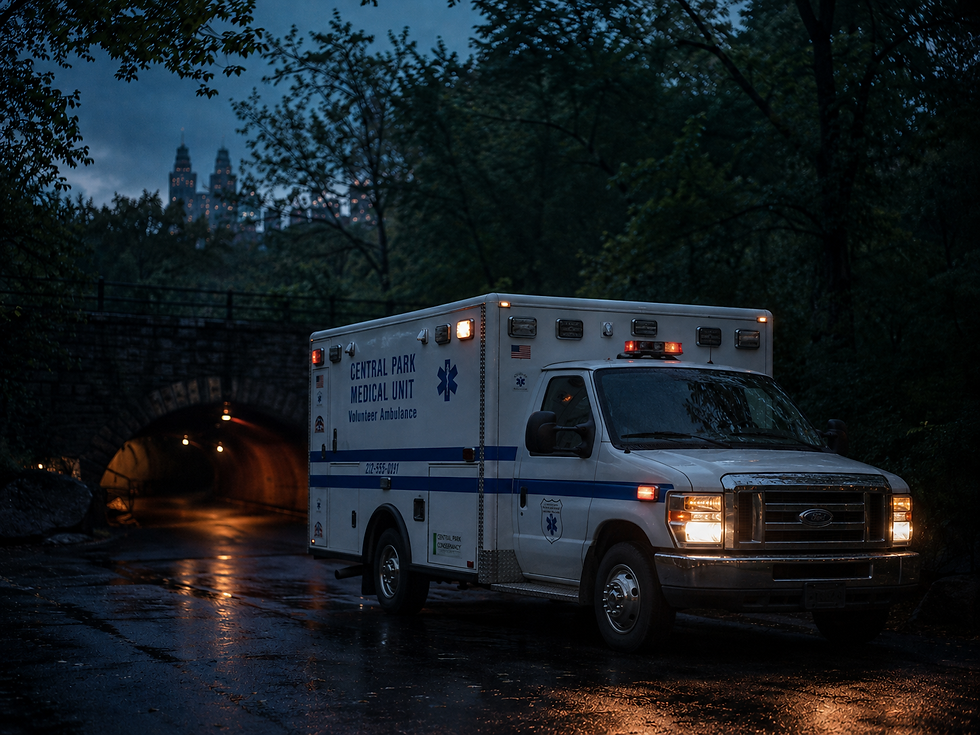
The Central Park Medical Unit is one of the strangest and most instructive EMS organizations in the country. It runs about 3,000 patient contacts a year inside the world's most-visited urban park, on donations alone, with roughly 150 volunteers and a fleet of Type II vans that were bought and built specifically because they clear the roof height of the park's transverse tunnels. It bills no one — not patients, not insurance, not the City of New York. It has been doing this since 1975. In its 51st year it is worth studying.
The Solution to a Tricky Problem: Central Park Medical Unit
In the mid-1970s, if you went down inside Central Park — cardiac arrest, seizure, cyclist versus pedestrian on the Loop — the response you got was a Manhattan municipal ambulance trying to find you inside 843 acres with no addresses, no cross streets that made sense to a dispatcher, and a network of curving carriage roads that don't behave like a grid. Response times ran 45 to 60 minutes. Sometimes the patient died. Sometimes the patient walked out.
A group of park regulars — bicyclists, runners, park-precinct volunteers — decided the park needed its own EMS. According to CPMU's own history, the founding cohort in 1975 included Dean Esserman, Jonathan Fram, John Schwartz, Michael Ussak, Arthur Funn, Dorothy Marks, Brian Donnelly, James Finley, Robert Glassbunn, Paul Saccento, Frederick H. Kingsbury III, and Rafael Castellanos. They started with about twenty volunteers, personal bicycles, and a single retrofitted Ford van. They called themselves the Central Park Medical Rescue Squad. The Central Park Precinct Community Council chipped in seed money. In 1976 they bought a used 1972 Chevy Type II from Lenox Hill Hospital, which was the moment the squad went from first-response to transport-capable. In 1979 they incorporated as a 501(c)(3) and renamed themselves the Central Park Medical Unit.
Fifty years later, Castellanos is still there. West Side Spirit ran a profile of him in 2022 headlined "Five Decades of Free Care." He is now the corps president, and CPMU credits his continuous involvement as beginning in 1973, which predates the formal organization. In January 2013 the Obama White House sent written remarks recognizing Castellanos's 40 years of service — presented at the Central Park Precinct Community Council in the Arsenal. In June 2025 CPMU threw its 50th Anniversary Gala and minted a 2.5-inch challenge coin to commemorate it. In February 2026 the NYC Department of Citywide Administrative Services devoted an entire issue of its official Fleet Newsletter (Issue 523) to the unit — a rare civic acknowledgement of an organization that is not on the city payroll.
How the Model Actually Works
CPMU is licensed at the BLS level. Its members ride under the New York City Regional Emergency Medical Advisory Committee (REMAC) unified prehospital treatment protocols — the same protocol document FDNY EMS runs on, promulgated under New York Public Health Law Article 30. When a CPMU unit is on-duty, it is placed into the FDNY EMS 9-1-1 resource pool. Calls inside the park get CPMU as the BLS backbone; if the patient needs ALS, FDNY paramedics roll in and take over the interventions that BLS is not authorized to perform. Under the REMAC General Operating Procedures, a BLS crew "must relinquish patient care to an ALS provider who requests it" — the handoff is not optional and not negotiable, which is the correct arrangement for a corps operating at BLS scope inside a paramedic-tiered system.
BLS in New York carries more than the classroom implies. CPMU units carry an AED (the 27 April 2013 save was documented AED shocks), OPA/NPA/BVM airway management, oxygen, hemorrhage control kit, oral glucose, epinephrine auto-injector, and intranasal naloxone — all within statewide BLS scope. Nothing that FDNY-M paramedics carry is off-limits to the patient once the paramedic rig is on scene. What CPMU delivers is the first three minutes of livesaving care - which has made a tremendous difference across the years to NYC Central Park's visitors.
The corps is a 501(c)(3) public charity, IRS EIN 11-2516283, filed under NTEE classification E62 (Ambulance / Emergency Medical Transport Services). The most recent Form 990 available on the IRS/ProPublica trail — fiscal year 2024 — shows revenue of $163,594, expenses of $117,454, net income of $46,140, and net assets of $644,702. Contributions were about 84 percent of revenue. The other 16 percent was investment income. There is no line for patient revenue because CPMU does not bill patients. There is no line for city or state funding because it takes none. Charity Navigator gives it a three-out-of-four-star rating, weighted heavily on Accountability and Finance. The corps operates from quarters at 86th Street and the Transverse Road, physically inside the NYPD Central Park Precinct — an embedded relationship that keeps overhead low and coordination high.
The medical director is Michael P. Jones, MD, FAAEM, interim chair and professor in the Department of Emergency Medicine at Montefiore Einstein. An assistant medical director listed publicly is Josef Schenker, MD, MBA, NRP, FACEP, FAEMS — who is also the current chair of NYC REMAC. That is not a coincidental line item. It matters that the corps's medical oversight includes the physician who chairs the regional protocol body: it tells you CPMU's oversight is not a rubber stamp signed by a private-practice generalist who wanted to help out a nonprofit.
The Fleet Built for the Tunnels
The park's four transverse roads run at a lower grade than the surface streets, and the tunnels that carry them under the pedestrian park are not built for tall boxes. Rolling a Type III box ambulance into Central Park is an engineering problem. CPMU solved it by building its rigs on Ford E-350 Type II van chassis — lower roofline, tighter turning, and a wheelbase that behaves inside the park's carriage roads.
The fleet, based on cross-referenced public builder profiles and CPMU own material:
Unit 8 — Ford E-350 / MedTec Type II
Unit 9, Unit 10, Unit 11 — Ford E-350 / Horton Type II ambulances (Bus 11 was donated by the estate of longtime volunteer Brennon Jones, who died 2 February 2014)
Unit 3 — 2019 Ford Police Interceptor Utility fly-car, stationed at the Central Park Precinct
John Deere Gator 4x4 ATV, built out by Neville Fleet Service for off-road response into the Ramble, the Great Lawn interior, and other spots where a van cannot go
Bicycle Emergency Response Team (BERT) — a mountain-bike team of roughly ten EMTs during warm months, running in two-EMT elements with mounted trauma packs and AEDs
The BERT is not decoration. Stateline profiled it in a 2017 national feature on bicycle EMS as a working model. Inside a crowded event — a NYRR race, a Great Lawn concert, a marathon Sunday — a bike is faster than a rig, and a two-EMT bike element beats a Type II to the patient by minutes.
CPMU also lost fleet the hard way. On 20 November 2014 a fire at a commercial garage on West 108th Street destroyed two CPMU ambulances — the corps's oldest and newest — each valued at $150,000 to $200,000 with equipment. NYPD sources called the fire suspicious. Public reporting shows no resolution. CPMU launched an online fundraiser and reported roughly $40,000 raised from about 180 donors within four days. They rebuilt and that not only demonstrates their tenacity and grit, but also their love for their fellow man.
How Someone Gets on the Bus
CPMU does not train EMTs. Applicants have to arrive already certified at NYS EMT-Basic or higher. The corps says so on its own volunteer page: "CPMU does not provide EMT certification training or refreshers." From application to riding, the timeline is measured in months. The Breezy careers page states it can take up to three months to process the application and six to twelve months before a new member is cleared to run on an ambulance. Members commit to a minimum of two years and to at least two shifts per month of eight consecutive hours, weekend availability included.
That is a great filter. It rules out anyone hoping to volunteer at the pace of a Saturday-morning hobby, and it rules out anyone who cannot be trained to a corps standard on top of a certification standard. What you get on the roster is a self-selected mix of about 150 members: professional EMTs, paramedics, nurses, physicians, executives, attorneys, current and retired law enforcement. What you get in return is a crew that has trained together, that knows the park, and that shows up.

The Standby Book
CPMU's operational rhythm is weekends, holidays, and events. It is not 24/7 municipal service; it is a targeted overlay onto FDNY EMS coverage, aimed at the load that predictably spikes inside 843 acres of dense-use urban park. The standby book runs long: the New York City Marathon (finish line and closing miles), the New York Philharmonic in the Park, SummerStage, NYRR races, the Global Citizen Festival and other Great Lawn concerts, the Parkinson's Unity Walk, and — outside the park — mutual-aid coverage on the Puerto Rican Day Parade and Macy's Thanksgiving Day Parade, plus city-wide MCI mobilization "in times of crisis," as the corps puts it in its own materials.
The published annual patient contact figure — about 3,000 per year — is the number a working medical director cares about. It is the number that says this is not a mascot program.
The call mix is not published in detail, but from documented incidents and the event profile you can predict it: cardiac arrests, syncope at concerts (heat, alcohol, standing-still-in-a-crowd vasovagal), heat and hydration collapses on marathon Sunday, cyclist-versus-pedestrian trauma on the Loop, cyclist-versus-cyclist trauma at the same intersections year after year, pediatric injuries at Wollman Rink in winter, and the routine assault, seizure, diabetic, and behavioral calls that any dense urban gathering generates.
What Civilian EMS Can Steal
A working EMS chief reading this should be pulling out three lessons.
Hyper-local geometry beats jurisdictional coverage. The reason CPMU exists is that the surrounding municipal service could not solve the addressing problem inside 843 acres. If you have a venue — a stadium, a fairground, a university campus, a national park — where response times fall apart at the entrance, you have the CPMU problem. The answer is not to yell at dispatch. The answer is embedded response that lives inside the venue, trained to the venue, dispatched into the venue, and integrated as a BLS overlay under existing paramedic protocols.
BLS in the first three minutes buys ALS everything. The 2013 cardiac save is the archetype: bystander CPR, an EMT-B crew arriving in under three minutes with an AED, VF converted, then FDNY paramedics take over ALS and transport. That is the correct division of labor in an urban system. It does not require paramedic-scope on the first-arriving unit; it requires that a first-arriving unit exist and that the patient be worked competently for the first three minutes.
Volunteer models can hit a professional standard if selection is real. CPMU’s front door is closed to anyone without a state EMT card, and a new member does not touch an ambulance for six to twelve months. That is the difference between a hobby corps and a working corps. Most volunteer EMS programs that collapse do not collapse because volunteers are unwilling; they collapse because leadership let the front door swing.
The Next Fifty
The corps enters its 51st year with what looks like an ordinary charity ledger — a few hundred thousand in annual revenue, an embedded quarters arrangement at the Central Park Precinct, a fleet rebuilt after a suspicious 2014 arson, a medical director who chairs an EM department, and an assistant medical director who chairs the regional protocol body. Its 2025 anniversary gala was less a victory lap than a capital appeal for the next fifty years.
If you work civilian EMS anywhere near a large venue, CPMU is worth two afternoons of your time. Read the REMAC unified protocols. Read the 990. Read the Breezy job description. Notice what the corps has decided to spend money on (Type II ambulances built for tunnel clearance, an ATV built out by a professional fleet shop, a bike team that runs during the months the patient volume actually happens) and what it has decided not to spend money on (billing infrastructure, paid staff, city subsidy). Notice which decisions age well.
CPMU may be focused on Central Park in New York City, but we at Black Flag EMS are hopeful that the can-do attitude, standards and passion that they and their members embody reach far beyond the limits of Central Parks 843-acres. If you wish to learn more about CPMU, check out their website.
Sources for this piece (accessed 2026-09-01): Central Park Medical Unit official website (cpmu.com — History, Leadership, Volunteer, 50th, Special Events, News); NYC REMSCO / REMAC 2024 Unified Prehospital Treatment Protocols; ProPublica Nonprofit Explorer (EIN 11-2516283); Instrumentl Form 990 report; NYC DCAS Fleet Newsletter #523 (12 Feb 2026); JEMS coverage of the 2013 cardiac save; West Side Spirit profile of Rafael Castellanos, "Five Decades of Free Care"; CBS New York and EMS1 coverage of the 20 Nov 2014 garage fire; Stateline "Bike Medics" feature (30 Jan 2017); Central Park Conservancy visitor information; Breezy HR careers page for CPMU; Neville Fleet Service builder profile of the CPMU John Deere Gator.


Comments